There seems to be a growing disconnect between the general public and the tech industry in evaluating the pace of AI progress. Andrej Karpathy just published a very interesting post to explain this gap.
I believe there's a more fundamental reason why the general public feels that AI has plateaued over the past 18 months: for most use cases, intelligence exhibits a decreasing marginal utility.
The recent jumps in model competence have therefore not yielded any significant increase in the value the general public could extract from LLMs.
Most things in life - including intelligence - exhibit decreasing marginal utility
When you’re hungry, the first plate of food provides great pleasure. The second plate less so. You wouldn’t blame the chef for that. Likewise, going from a 50 Mbps to a 500 Mbps internet connection fundamentally changes your experience (you can now stream movies in HD), but going from 500 Mbps to 5 000 Mbps feels negligible (web pages load at almost the same speed). It would be misguided to accuse your internet provider of technological stagnation.
For the majority of current LLM use cases (general knowledge, travel itineraries, recipes, psychological advice, etc.), we probably reached the “500 Mbps” mark around 18 months ago. Current models were already exceptionally useful then, and each additional unit of technical progress no longer yields a full unit of user satisfaction.
Of course, some people (software engineers, people building agentic workflows, or working on complex maths problems, etc.) still benefit greatly from the jump in capabilities. But soon, even they will face the second barrier: the limits of human perception.
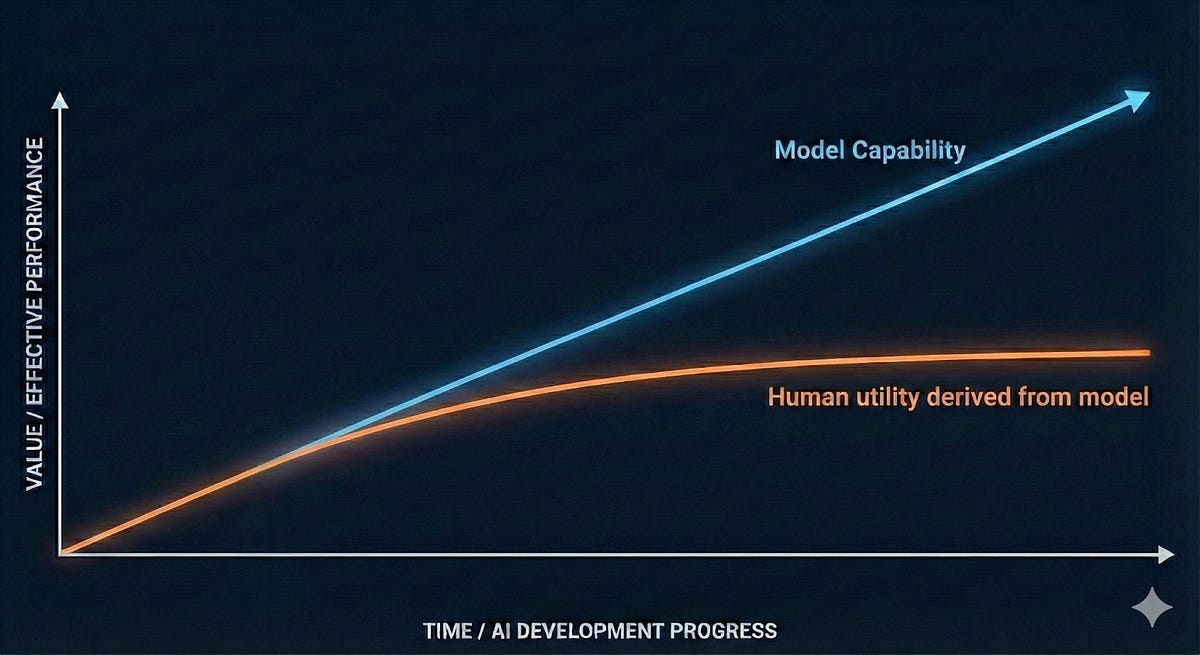
Human intelligence as the ceiling to understanding AI progress
Consider image resolution. When a screen improves from 240p to 480, we see a huge jump in quality. When it upgrades from 4K to 8K, we see no difference because our retina physically cannot render the extra pixels. Likewise, AI capability is not observed directly, it is sampled through human perception. Once AI improvements exceed our evaluative capacity, progress continues, but our perception of it stalls.
A chess amateur cannot tell the difference between a 2800 Elo and 3200 Elo engine. To him, both appear to play “perfectly”. Similarly, we would perceive an AI plateau even in the absence of plateau, when improvements happen at altitudes we can no longer monitor. (Although the improvements may of course matter a lot in an aggregate economic sense or for frontier scientific discovery).
In other words, the ceiling we will hit is not that of artificial intelligence but of natural intelligence. The models will continue getting smarter, but we won’t be smart enough to utilize (or even notice) that extra intelligence. And we might confuse saturation of utility with stagnation of capability.