I am delighted that Fakto chose Frst to lead their $4,2m seed round.
There’s the obvious: a stellar team (I have been friends with Charles, the CTO, for 15 years, and he’s one of the smartest person I know) working in a large market, at the intersection of an old problem (contract leakage) and a new solution (AI).
But I’m also very excited about the deeper problem Fakto is, almost as a side effect, beginning to attack. Because beyond fixing how contracts are enforced today, Fakto could eventually reinvent how enterprise contracts are designed in the age of AI.
The more clauses, the merrier
A naive view treats clauses as zero-sum: a concession that benefits one side must come at the expense of the other. This, of course, couldn’t be further from the truth. Clauses are often negotiated not to divide but to create value. Economists have spent decades studying how well-designed clauses can leave both parties better off.
Take probation periods in employment contracts. They could appear unfavorable to employees (who can be dismissed more easily). But by reducing the employer’s downside risk, they make hiring less risky. The result is more hiring, and more opportunities for employees.
Similarly, clauses that make tenants (rather than landlords) pay for the electricity they use incentivize tenants to limit their consumption. This creates an economic surplus that can be shared, for example in the form of a lower base rent, ultimately benefiting both parties.
Likewise, clauses that commit a buyer to purchase a minimum volume of a good, while seemingly reducing his freedom, give his supplier certainty over demand and allows him to invest in supply chains or R&D, ultimately increasing the total surplus.
The general principle is that the better designed clauses are, the more they align incentives and the more economic value they create. Enterprise contracts are not static legal records but incentive systems.
Unfortunately, contract complexity is (or was) capped
Designing granular clauses often requires complexity, and contract complexity has been capped by two ceilings:
Human cognitive abilities (humans can only design contracts that other humans can read, negotiate and execute)
Deterministic software (which can only handle structured fields rather than subtle, context-dependent logic)
In practice many contracts are therefore imperfectly designed. Actors behave rationally, but only do so given the imperfect incentives set up by contracts. This creates frictions and deadweight loss across the economy.
The Prisoners’ Dilemma revisited
One way to visualize this friction could be to see the economy as a web of mini prisoners’ dilemmas. The canonical Prisoner’s Dilemma can indeed be thought of as an imperfectly designed contract penalizing both parties.
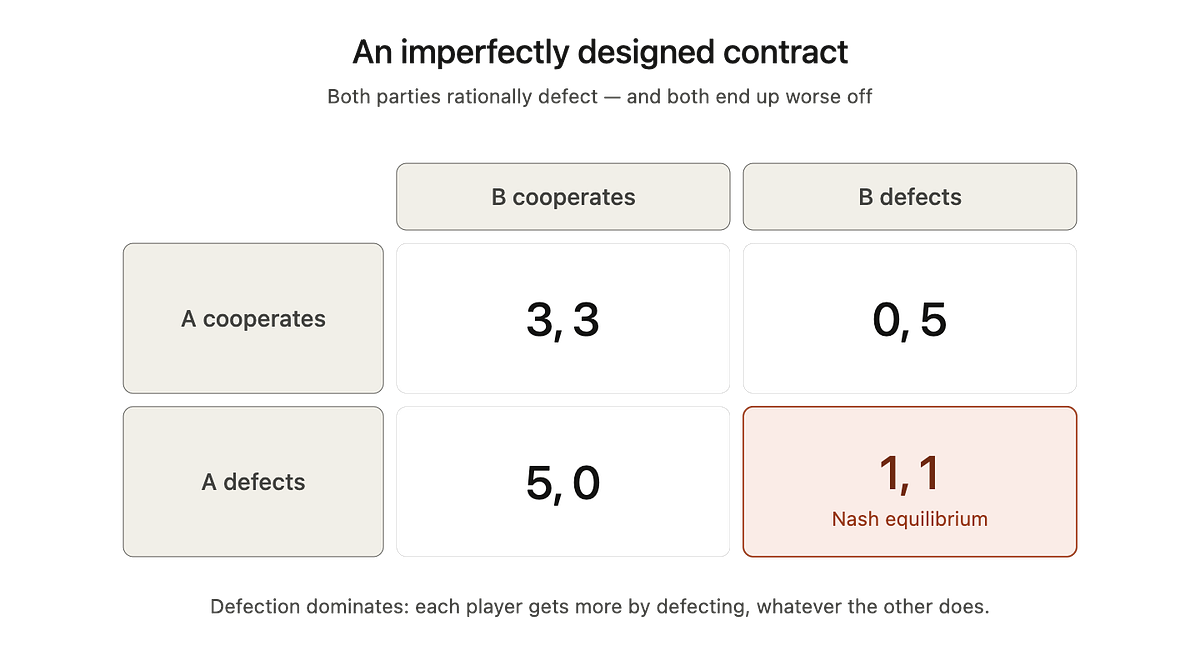
In this scenario, both prisoners prefer to defect, regardless of what the other does. The Nash equilibrium is the bottom right corner. Both parties are rational, but the clauses (the rewards in the payoff matrix) encourage a bad outcome for both parties.
Now tweak the clauses slightly, reducing the reward for defection:
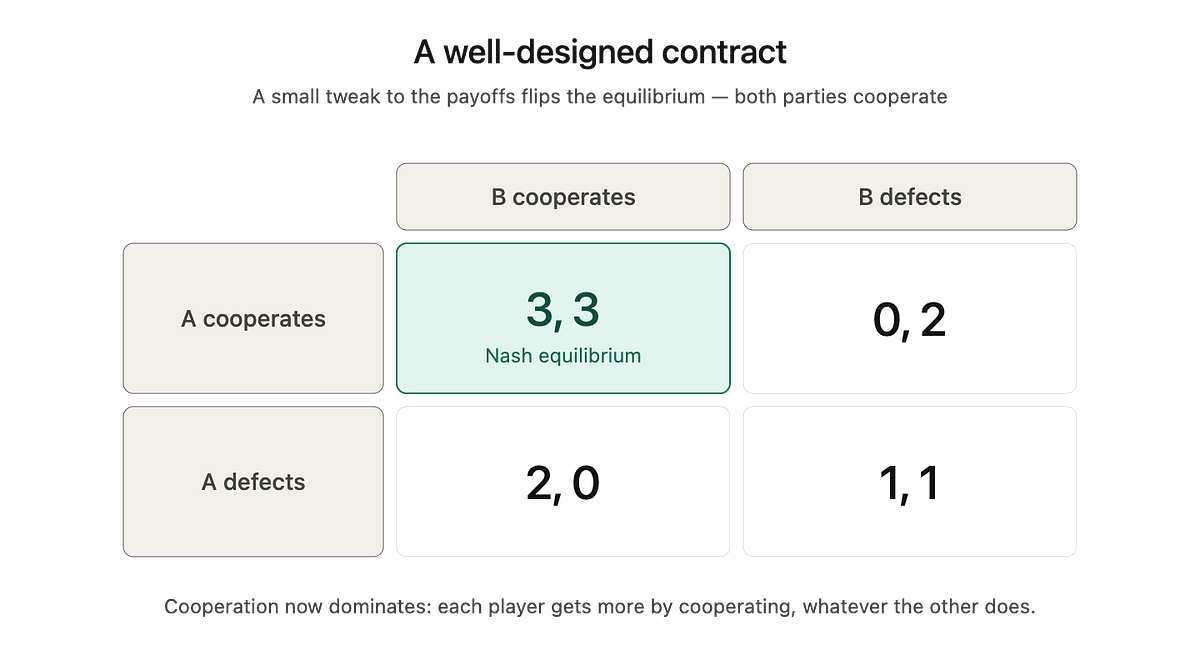
Incentives are now aligned. Regardless of what the other does, each prisoner will prefer cooperating, ensuring they do indeed both cooperate. The Nash equilibrium shifts to the top left corner.
Both parties would happily commit to this modified contract - even though all it does is reduce their payoff in some states of the world. They benefit from tying their own hands, like Odysseus who tied himself to the mast so his future self could hear the sirens without dying.
But in the real world, tweaking that reward matrix was often impossible: it required adding clauses too complex for humans to write, sign and enforce. So the better contract did not exist.
AI takes us towards the healthy Nash Equilibrium
With AI, this is changing. Both of the ceilings to contract complexity (cognitive and software) are giving way at the same time: it will be possible to align incentives at a granularity that was previously out of reach.
For example, it becomes possible to specify a vast number of contingencies (If demand falls below X, adjust price by Y ; If inflation rises above Z under condition W, trigger clause Q, If quality falls within range T, apply proportional adjustment U, etc.). It also becomes possible to rely on continuous (rather than discrete) clauses, optimizing incentives at the margin. Or to move from a single negotiated number to a formula that adjusts as costs move, from trust-based informality to explicit incentive design, etc.
As AI takes over contract design and execution, clauses will get more numerous and more complex, and that is good news. AI expands the feasible complexity frontier of economic coordination.
Millions of economic interactions will move from the first Nash equilibrium to the second.
Fakto’s wedge, and where it could lead
Fakto starts from a concrete problem: enterprise contract leakage. The gap between what’s negotiated with suppliers and what happens after signature. It’s a real, urgent pain (across large enterprises, 2 to 5% of procurement spend evaporates between negotiated terms and actual payments, because rebates are misapplied, indexation formulas drift, penalties go uncollected, and so on).
But as Fakto comes to sit across thousands of contracts and their downstream financial reality, a feedback loop emerges: which clauses actually capture value, which become dead letter, which create perverse incentives, which trigger disputes, etc. That data can turn Fakto into a contract design layer, a system that helps companies, and eventually their counterparties, write better contracts, grounded in empirical evidence of what works in a given industry, with a given supplier base, against a given operational reality.
That sets the path towards reinventing how contracts are designed and executed in the age of AI, adding value for both sides of every deal in the process.
I can’t wait to see what Nicolas, Benjamin and Charles build.